Spoiler alert: It’s not the vermouth.
Here’s an actual conversation I had at a recent spirits tasting—and l have some version of this conversation at least once a week with someone somewhere:
Customer: “Oh, I like that cocktail. I hate dry vermouth, but I like that cocktail.”
Me: “Why do you hate dry vermouth?”
Customer: “Because it tastes terrible.”
Me: “Hmmm. Do you have dry vermouth at home?”
Customer: “Yes.”
Me: “Do you keep your dry vermouth in the refrigerator?”
Customer: “No.”
Me: “And how long have you had that bottle of vermouth?”
Customer: “Forever, I guess.”
Me: “Then I know why you think you don’t like dry vermouth.”
And … scene. We’ll be back in a moment, after this word from our sponsor, vermouth:
VERMOUTH IS WINE. VERMOUTH. IS. WINE.
At another recent tasting, one woman looked at a cocktail recipe I featured, then looked up at me and said, God bless her, “What is vermouth, anyway??” The good Lord loves a curious mind, and so do I; not enough people ask this question.

Vermouth is wine—aromatized for flavor and enjoyment, and fortified (i.e., the makers added alcohol) for stability. (In some cases, such as Noilly Prat, it’s also slightly barrel aged.)
And why on earth would anyone ever mess that way with a perfectly good wine?
“Aromatizing” means macerating various herbs, spices, barks, flowers, roots, etc. in a wine to create a desired profile of flavors and (of course) aromas. As long ago as 4000 BCE, humans did that for either or both of two reasons: The flavor of primitive wines was awful, and/or the substances used to aromatize the wines were considered medicine … and also tasted awful, but when taken with alcohol became a more attractive proposition. Today we aromatize wines to add pleasant flavors and aromas, not to mask bad ones.
“Fortifying” wines involves adding a distilled spirit—typically brandy or a neutral spirit—to a wine as it nears completion of fermentation. Boosting the alcohol content of a fermenting wine to about 15-16 percent by volume kills any remaining active yeast cells, halting fermentation and leaving some amount of unfermented sugars in the wine so it will taste sweeter. The higher alcohol also kills or inhibits growth of organisms other than yeast cells that could multiply and eventually spoil the wine.

During the Renaissance and “age of exploration,” fortified wines became a staple on long sailing voyages and in the homes of wealthy gentry. In the warm climate along the Mediterranean shore and in the holds of that era’s lumbering sailing ships, conventional table wines tended to spoil before they could be enjoyed, and fortifying them kept them from spoiling as quickly. Plus, it turned out that fortified wines can be very, very enjoyable. Port wine, Madeira, Marsala, and sherries are all fortified wines, each made with different methods and, originally, in different regions around the Mediterranean. So is vermouth, which emerged in Northern Italy, Southern France, and along the Mediterranean coast of Spain during the 17th and 18th centuries, first as a cottage-industry product in apothecaries (based on recipes dating back to the Roman Empire), and eventually as bottled products for mass production.
WHAT ON EARTH DID THEY DO WITH VERMOUTH 300 YEARS AGO??
Vermouth is one of the most misunderstood, under-appreciated, and even disrespected beverages on the American cocktail scene—widely considered most useful for ruining Martinis. But along the Mediterranean coast of Europe, where vermouth emerged (centuries before there were gins or whiskeys to mix with it), it’s always been considered an elegant, improved form of wine and consumed by itself as an aperitif or casual cocktail for any time of the day or night. It’s usually enjoyed chilled and neat, or over ice, with a twist of lemon or orange peel.

Vermouth was respected here in the United States, too, before Prohibition and a global war disrupted and corrupted American cocktail culture. In tony saloons of the late 1800s and early 1900s, vermouth was often the star in cocktails instead of a supporting actor. A Manhattan would have been two ounces of Italian (a/k/a sweet) vermouth and just one of whiskey; same for the Martini’s grandpappy, the Martinez—two ounces of Italian vermouth and one ounce of Old Tom Gin.
Good news: Vermouths are having a moment and regaining their rightful place in classy saloons and home bars alike. There are dozens and dozens of them available, based on a variety of wines and applying an amazing diversity of botanicals; no two are the same. Across the category, modern vermouths are pleasingly affordable, immensely useful, and delicious to enjoy neat or in easy-to-make cocktails—even lower-alcohol vermouth-led cocktails.
WHY VERMOUTH GOES “BAD”—AND HOW LONG IT TAKES
Because it’s fortified, vermouth has a *longer* shelf life after opening than a typical dinner wine, but it is wine nevertheless, typically with alcohol content between 16 and 22 percent by volume. While that slightly elevated alcohol level is has a preservative effect, keeping micro-organisms from spoiling the wine, oxygen still combines with the phenolics in a vermouth (as with any wine) to begin oxidizing its alcohol the moment you open a bottle. It doesn’t last forever.
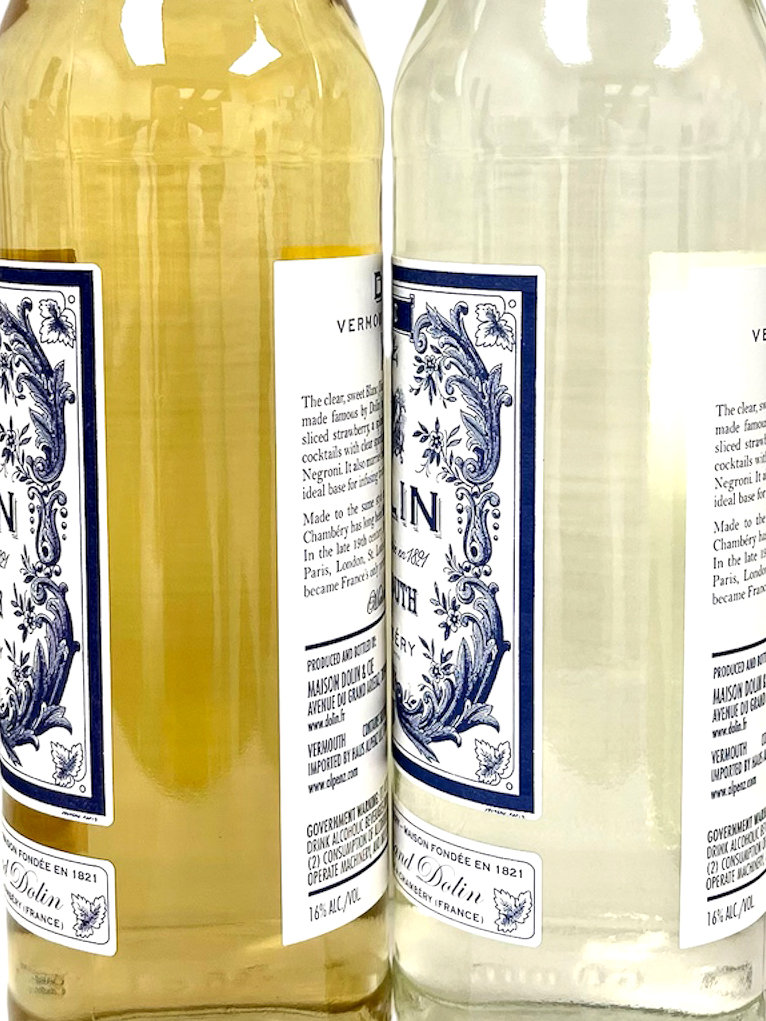
How bad is bad? Oxidation of alcohol creates acetaldehyde, which has a green or sour apple smell, and eventually volatile acids form that can begin to smell vinegary. As components of the wine oxidize, it darkens. Alcohol’s volatility carries aromas to your nose, and with progressively less alcohol in oxidizing vermouth, it gradually loses its sensory appeal…and other things can eventually start to grow in it. Figure 1 shows identical bottles of Dolin Blanc vermouth; the one on the right is fresh and unopened, so almost water-white. The open one on the left sat in my cool, dark basement for about three years. Note the color change, and don’t try to tell me vermouth doesn’t go bad.
Oxidized vermouth won’t kill you, but after 4-8 weeks, even refrigerated, vermouth will be noticeably less enjoyable than when you first opened it—flat and not as flavorful. Leave an open bottle of it in a kitchen cupboard or (worse yet) on a sun-drenched shelf for a year or more, and you’ll have a biology lab going on. Bottles like that are why so many people *think* they don’t like vermouth.
Don’t just take my word for it; you can prove this to yourself by comparing the flavor of a vermouth you’ve had open for months with the flavor of the same vermouth from a freshly opened bottle.
For that matter, try making identical cocktails, one with vermouth from a weeks- or months-old bottle and one with vermouth from a freshly-opened bottle. I think you’ll agree that the one with fresh vermouth is distinctly better—and why would you not want to have the best possible cocktail you can make?
Certainly, you may not like *all* vermouths equally, but if you keep trying new ones you’re bound to find some you really enjoy. The question I always ask, when a customer tells me they don’t like a certain variety of wine or type of spirit is, “Have you tried them all?”
HOW TO CARE FOR YOUR VERMOUTH
Smart vermouth care starts at the shelf in your liquor store of choice. Vermouth comes in bottles of various sizes, from 50 milliliter “airplane” bottles (rare, but they do exist) up to 1.75 liter “magnums.” Try not to buy a bottle that will last more than a month at your usual pace.
I’ll go even farther. I don’t care if you actually do use an entire liter or magnum of vermouth in a month. Just buy small bottles so you’ll always be using *fresh* vermouth. (My go-to is 375 ml when that size is an option.) Those liters and magnums of vermouth belong only in busy bars. And maybe not even there.

When you open a bottle of vermouth:
- Mark the opening date on the back label with a Sharpie or similar marker
- Store the opened vermouth in your refrigerator
- After it’s been open for two months at most, discard what’s left (or try some of these ideas for using slightly over-aged vermouth)
PARTING SHOT
There are many, many, many brands of vermouth on the market here in the United States, and some are better than others. I have opinions in that regard, but I’m choosing not to offer them right now, because the principles I’ve addressed in this post pertain to all of them:
- Vermouth is wine.
- It will oxidize after opening; refrigerate it to slow the oxidation.
- Its best shelf life after opening is no more than 4-8 weeks, even refrigerated.
- It can be enjoyable by itself as well as in a cocktail.
After you open a nice bottle of Chardonnay or Cabernet Sauvignon, do you keep it unrefrigerated and sitting around open for a year or more before finishing it? I think I heard you say no—at least, I hope I did.
Then you shouldn’t do that with vermouth, either.
Want to do a deeper dive on vermouth and try a variety of styles? Contact me through this site about my seminar, “Vermouth: A Star is Reborn.”
 The Libation Lounge
Pingback: Cocktail of the Week: Blanc Vermouth | The Libation Lounge
Pingback: Cocktail of the Week: Wet Martini—but wait! It’s not what you think. | The Libation Lounge
Pingback: Cocktail of the Week: Wet Martini—but wait! It’s not what you think. | The Libation Lounge