The riddle: Two Dutchmen walk into a bar, and each orders a Dutch Martini, but neither gets the same drink. What’s up with that??
I tripped across the Dutch Martini on a search of the very excellent Difford’s Guide website for another recipe, and when I did a wider internet search, I found at least three other variations on it. I’m going to feature two recipes in this post.
But before we get to the recipes, talking Dutch cocktails requires some understanding of the Netherlands’ logo spirit.
What is genever, and why is it called “Dutch Courage?”
Genever (pronunciation: yeh-nay-ver) is a spirit made from malted spirits of barley, rye, wheat, corn, or other grains and flavored with juniper and other botanicals. In 2008, the European Union awarded genever a Protected Geographical Indication that limits production of it to the Netherlands, Belgium, a couple of departments in France, and certain areas of Germany. Given the diversity of languages and culture in genever country, it is variously known as jenever, genièvre, genever gin, Holland gin, or Dutch gin. Or … Dutch Courage.
What does it taste like? It is sweet and malty, and the juniper is distinct in most versions of it. There are two styles of genever: Oude (“Old”) and Jonge (“Young”), and neither of those labels has anything to do with the actual age of what’s in the bottle. They refer to the age of the style. Oude genever is the original style and required to contain more than 15% malt spirit; it’s pale-colored and somewhat sweet. Yonge genever is drier and lighter-bodied, and it’s required to contain less than 15% malt spirit. Neither requires any aging, but aging is permitted and often done.

But genever is not gin. Genever is generally considered a precursor of gin, first created in the region of what today we know as Belgium and the Netherlands, where English mercenaries learned of it as they fought alongside Dutch soldiers against Spain during the 17th century Thirty Years War. Noting that their Dutch comrades consumed immense amounts of genever to ward off fatigue and fear, apparently quite effectively, the Englishmen dubbed the spirit “Dutch Courage.”
Here’s my 25-cent, shorter-than-reasonable history of gin: The Dutch invented genever, and the English discovered they liked it. But when the English went home and attempted to make genever, they didn’t quite get it right; what they came up with was roughly what we now call “Old Tom Gin,” and Old Tom dominated American gin cocktails until Prohibition. But around 1830, an Irishman (Aeneas Coffey, for you trivia players) perfected the column still, enabling development of what we now know as the London Dry style of gin—clear, crisp, and dry, permitted to have no more than 0.1 gram of sugar per liter. Therefore, while genever is not gin, I like to call it the “proto-gin.” (Click here if you’d like to read more about genever and its history, and here if you’d like to learn a little more about how genever and gin are related.)
Also, there’s this thing Dutch people do with genever called Kopstootjes—literally translated, “little head butts.” It’s basically a shot and a beer done in a very particular way. Here’s a fun video that demonstrates Kopstootjes, but without the head-butt part. My understanding is that friends should gather around a table or at the bar and do this together, so that they almost knock their heads together when they go in for the brim-full shot of genever. Apparently this is not rigidly enforced … .

Anyway, let’s move on to the less head-butty world of the Dutch Martini.
The Dutch Martini(s)
The definition of a classic Martini is gin and dry vermouth, and the Dutch Martini starts with *approximately* gin—genever, of course—and dry vermouth. And maybe other stuff, too. That said, my favorite recipe for a Dutch Martini, among the several I found, is more Dutch vodka than genever (it includes both).
Yet I didn’t see anyone calling that a “Dutch Vesper.” Would James Bond kill anyone for that?
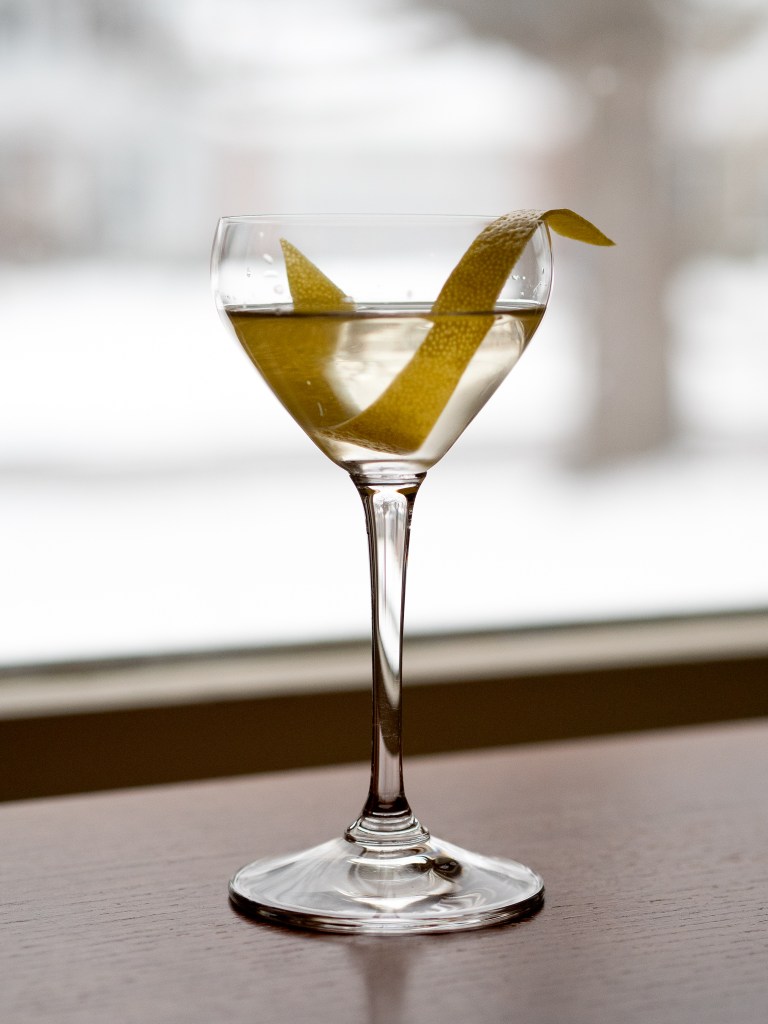
Ideally, a Dutch Martini should be made entirely from Dutch ingredients, of course, but while I know a lot about vermouth (it’s one of my pet cocktail topics), I can’t tell you if there is a Dutch dry vermouth, so we’re on our own for that ingredient. I used my go-to, Vya Dry Vermouth.
And as long as we’re not using a Dutch vermouth, I will ask your forgiveness in advance for not using the Dutch vodka, Ketel One, that Simon Difford prescribes in his recipe; I don’t have a bottle of Ketel One in the house. Instead, since Ketel One is a wheat-based vodka, I used the excellent wheat-based vodka that I do have in the house: Hammer-Sickle, the Russian vodka. (For that I won’t beg forgiveness; Russia got my money for it long before its war on Ukraine. If this offends you, please read my post about Russian vodka boycotts from March 6.)
Here are the two Dutch Martini options I like best so far.
DUTCH MARTINI – THE ALTERNATE
1½ oz Oude Genever
¼ oz Dry vermouth
Stir the ingredients with ice in a mixing glass and strain into chilled Nick & Nora glass. Garnish with a twist of lemon.
This version is more in line with a traditional Martini recipe and highlights the rich flavor of the genever itself, tempered just slightly with the right amount of vermouth. It’s my second choice, though, because it risks losing almost all of its flavor from over-dilution by the ice. I’d suggest putting the genever in your freezer for an hour or two before cocktail time, or just keep it in there all the time (as I do with my go-to gins and vodkas) and giving it only a very quick stir with a little ice when you mix it.
DUTCH MARTINI – DIFFORD’S RECIPE
2 oz Ketel One vodka (or other wheat vodka)
¼ oz Oude Genever
1 tsp Pierre Ferrand Dry Curaçao
1 tsp Dry vermouth
Combine the ingredients in a mixing glass and stir them with ice until well chilled. Strain the cocktail into into a chilled Martini or Nick & Nora glass and garnish with an olive.
Of note, while the Pierre Ferrand Dry Curaçao is made in France, curaçao is a Dutch invention, as I mentioned in a previous post about orange liqueurs. In this most flavorful version of the Dutch Martini, I think it gives the vodka and even the genever a real lift. I like a dash of Fee Brothers Gin Barrel Aged Orange Bitters in my regular Martinis, so I guess it makes sense that I prefer this recipe.

 The Libation Lounge
Pingback: The Martinez | The Libation Lounge
Pingback: ‘Tis the season for a Christmas Cheer-y | The Libation Lounge
Pingback: Appease the Cheese | The Libation Lounge
Pingback: Cooks World/Pinnacle Liquor Cocktail of the Week: The Ampersand | The Libation Lounge