There is so, so, so much more in the world of Irish adult beverages than Guinness—not that there’s anything wrong with Guinness, of course. For the final 13 years of my full-time career, I worked for a naturalized Irish-American gentleman whose motto was apparently, “Who needs food when there’s Guinness??”
But yes, there’s more. According to the industry news organization Shanken, Irish whiskey was the third-fastest growing spirits category in the United States in 2021, outpaced only by tequila and pre-packaged cocktails.
What we’re witnessing and joining is the renaissance of the Irish whiskey industry, which was nearly strangled to death in the 20th century by U.S. Prohibition and Ireland’s own revolution against England—the United States and England were Irish whiskey’s biggest markets until the nineteen-teens. By the 1970s, there were only two Irish distilleries still in production, but the cocktail revival has given Irish distillers a welcome leg up. Today there are more than 40 working distilleries in Ireland.
The roots of Irish whiskey are the roots of all whisk(e)y

In fact, Ireland claims to being the birthplace of whiskey as we know it. Legends say Irish whiskey making began in the 13th century with Irish monks bringing the knowledge of distillation home as they returned from trips to the Mediterranean region; distillation had been introduced to Southern Europe by the Moors during their invasion and occupation of Iberia and other regions around the 9th century. The famously teetotaling Moors used distillation strictly for medicine, but Europeans quickly found what they considered its higher purpose.
Objectively, the first known written record of whiskey in Ireland dates to 1405, 90 years before the earliest written reference in Scotland. The Scots naturally argue they were first, but their deerhounds ate their homework. Those Gaels are always quarreling amongst themselves.
So as St. Patrick’s Day approaches, do consider honoring the Irish tradition with an exploration of the only thing the Irish love as much as poetry, song, beer, and potatoes.
Why so many Irish whiskeys are single: The rules and traditions
The nomenclature of Irish whiskey is a bit arcane (and the language of Scotch as well, but we’ll save Scotch for St. Andrew’s Day). If you’re pondering the growing number of Irish whiskeys on your favorite store’s shelves but find the labels daunting, here’s a brief user guide.
First, the term “single” in the varieties of Irish whiskey indicates the whiskey is distilled on the site of just one distillery. For example, “single grain” doesn’t indicate the use of just one grain; it indicates that the bottle contains a grain whiskey—most likely made from several types of cereal grains—that was distilled at one distillery. Likewise for “single malt”and “single pot still” Irish whiskeys.

Second, by tradition but not by law, most Irish whiskeys are triple distilled—i.e., run through a pot still three times before moving on to be aged. Each trip through a still removes more “congeners”—substances that originate from the source grains and fermentation and which flavor the liquor, some in undesirable ways, and some in pleasing ways. There are exceptions to this tradition, though. Some distillers choose to distill their spirit just twice, preserving more flavors, aromas, and character. Other whiskeys are distilled in column stills, a process that can purify a spirit even more thoroughly than three times through a pot still.
Third, Irish whiskey is required by law to be aged in Ireland, in wooden casks, for at least three years before bottling. The distillery may choose any type of cask, new or used (most prefer used), and the casks can be no larger than 700 liters (185 U.S. gallons). Irish whiskey must be either bottled in Ireland or shipped off the island in inert containers for bottling, subject to strict controls and verification of the whiskey’s safety and integrity. It absolutely may not be shipped off the island in any type of wooden container.
Single this, single that, and what’s this ‘pot still’ thing about?
The law requires any Irish whiskey to fall into one of four categories:
Single malt whiskey: Made from 100 percent malted barley, distilled in a pot still within a single distillery. These may be double or triple distilled. The taste is smooth, sweet, and malty.
Single pot still whiskey: Made by a single distillery from a mixed mash containing a minimum 30 percent each of malted barley and unmalted barley, and it may include up to 5 percent other unmalted cereal grains—usually maize, wheat, or barley. Compared to single malt whiskey, the unmalted component gives Irish pot still whiskey a “spicier bristle” and a thicker, more oily, mouth-coating texture.
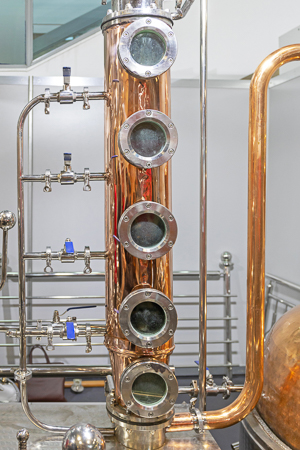
Single grain whisky: Made from a mash containing no more than 30 percent malted barley, and the rest may be any combination of unmalted cereal grains. Most grain whiskey in Ireland is produced from continuous distillation in a column still rather than a pot still, and most is used to make blended whiskey. The taste is sweet and light, with floral top notes.
Irish blended whiskey: Exactly what it sounds like, it’s a blend of two or more different whiskey styles. It may also be a blend of whiskeys from two or more distilleries. The flavors vary, but Irish blended whiskeys are beloved for their generally mellow and silky qualities.
Single pot still whiskey emerged first as a means to avoid a tax levied in 1785 on the use of malted barley—hence the mix of unmalted barley and, in many cases, oats. Although this tax was repealed in 1855, the popularity of the style endured until the emergence of blended whiskeys s in the late 19th and early 20th centuries. Despite the popularity of Irish blended whiskeys, though, the single pot still style is the most uniquely Irish in its history and qualities. The category name is at least a little confusing, if not a complete misnomer, because pot stills are used to produce at least three of the four legal categories of Irish whiskey, and it would be perfectly legal to use one to make single grain whiskey as well.
But, now that you have your Irish whiskey decoder ring, all you need to do is taste them. Slàinte Mhaith!
 The Libation Lounge
Pingback: The Brotherhood (Aye, but sisters like it, too.) | The Libation Lounge
Pingback: Cocktails of the Week: Five Irish whiskey riffs on cocktails you already love | The Libation Lounge